
AI project management
An AI project manager can mean two different things:
- A project manager running projects that build AI products, models, or agents.
- A project manager using AI tools to do the job itself, faster and with better context.
This article focuses on the second group: PMs who want to work more effectively with AI tools.
How the PM role changes with AI
Meeting tools like Fireflies, Otter, and Fathom now generate summaries, transcripts, and action items on their own. That means the PM stops adding value by acting as a human transcription layer. The value moves to checking that the summary is accurate, that decisions got interpreted correctly, that trade-offs are represented honestly, and that commitments actually turn into execution. That review step still matters, because AI is uneven at this: it speeds up throughput, but it can misread nuance at exactly the moment a PM is supposed to be protecting the project.
Team communication shifted too. Instead of chasing status across scattered Slack threads, docs, and meetings, PMs are turning to AI-powered search and issue systems that make project state something you can just query. Slack's enterprise search, for instance, is built to search conversations, data, and connected third-party apps from one AI search bar, with permission-aware results. Slack frames this as fixing a "hidden knowledge crisis," where information gets trapped in silos. Linear's Slack integration turns discussions into issues, syncs comment threads both ways, and pushes project updates back into Slack. The effect is that a PM's communication job becomes less about repeatedly asking people for updates, and more about building the system that makes those updates visible and searchable in the first place.
A practical tool stack for an AI project manager
The strongest recommendation out there right now isn't to buy one giant "AI PM" suite and expect it to solve everything. A smaller, more opinionated stack, where each tool does one job well and the PM wires them together deliberately, tends to work better.
- For meetings and follow-up, Fireflies, Fathom, and Otter all capture transcripts, summaries, and action items automatically, which cuts down on note-taking and keeps stakeholder communication more consistent.
- For the day-to-day work system, Linear fits well if your environment is product, engineering, startup, or software-heavy. Linear describes itself as built for teams and agents working from shared workflows. Its agent can pull context from the roadmap, issues, and code, spot repeated themes in a backlog, draft scoped starting points for specs, and answer questions like "what's at risk?" In Slack, it can turn conversations into issues, sync threads, and share updates. Linear Asks is particularly useful for taking in structured requests from non-technical teams.
- For resource planning and time tracking, resourceplanner.io works as a dedicated capacity planner and team time tracking software. It's built to schedule projects, allocate people, track time off and time spent in one shared calendar. Its MCP connector also makes it easy to plug into AI workflows.
- For Gantt charts, Tom's Planner lets a user describe a project in plain language and get back a structured Gantt chart with auto-scheduling. That's useful for client plans, kickoff packs, and any timeline you need to explain to people outside the project, since it shortens the gap between rough scope and something you can actually show someone.
- For company knowledge and an internal assistant, ChatGPT Business paired with Slack AI or Enterprise Search covers a lot of ground. OpenAI pitches ChatGPT Business as a shared workspace with admin controls and apps for company tools, with Business seats including Projects, Apps, Company Knowledge, ChatGPT Agent, Deep Research, and Codex. Slack's AI and search then handle the conversational retrieval layer across Slack and whatever else is connected. Together they cover most of what a PM needs to find answers across documents, conversations, and project systems.
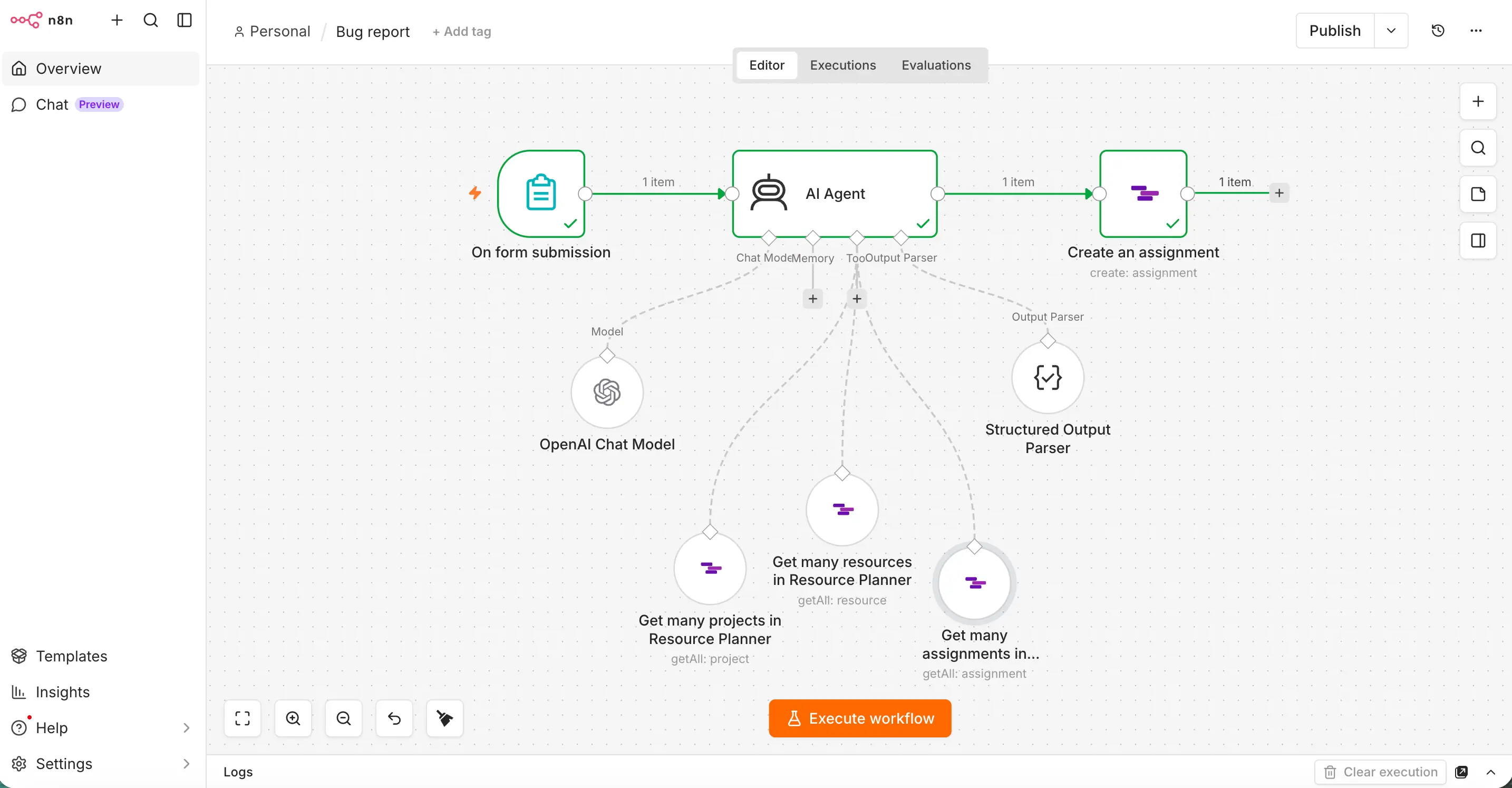
- For automation and workflow orchestration, n8n combines workflow automation with AI agents. Its design suits PM operations especially well, since it supports traceable reasoning on a canvas, manual approval steps, logging, memory limits, rate limiting, and step-by-step control over the workflow. That makes it a reasonable fit for routing meeting actions into issue trackers, building reporting pipelines, or setting up agent workflows that stay observable instead of turning into a black box.
What is the future of project management?
The future PM looks less like a scheduler and more like someone orchestrating humans, systems, and agents, building and delegating to them while still owning the outcomes. That's close to what good project leadership already looked like. AI just makes it explicit.
AI is taking over a lot of PM busywork, but that doesn't remove the need for a PM. It raises the bar on the PM's decision quality instead.
Will PMs get replaced entirely by AI agents? Nothing in the evidence points that way. What it does support is selective automation of the routine tasks. Gartner currently frames this as jobs getting redesigned rather than eliminated, and expects AI to create more jobs than it destroys starting in 2028. A Harvard-BCG study backs this up in a different way: AI outperformed people on many knowledge tasks, but did worse on a managerial task that sat outside what it was good at. That's why executive sponsors will keep wanting a human PM accountable for ambiguity, trade-offs, stakeholder trust, and escalation.